
Email hosting for small businesses goes beyond sending messages. It builds credibility, protects sensitive data, and ensures reliable communication. From bundled hosting to dedicated solutions, the right provider offers security, scalability, and real human support. This gives your business the professional foundation it needs to grow.
For small businesses, email remains the most essential channel for communication. It’s how you connect with customers, manage client relationships, and coordinate with team members. Yet, many businesses still rely on free services like Gmail or Yahoo. While convenient, those options lack the professionalism, control, and security that come with business email hosting. Choosing the right email hosting provider can strengthen your brand, protect sensitive information, and create a foundation for growth.
This guide will help you understand what email hosting is, explore your options, compare leading providers, and highlight the features that matter most for small businesses.
What Is Email Hosting
Email hosting is a service that lets you create and manage email accounts using your own domain. Instead of sending messages from [email protected], you can send from [email protected]. This simple shift carries big advantages for credibility, branding, and security.
Email hosting differs from web hosting and domain hosting. Web hosting focuses on making your website accessible, while domain hosting registers your domain. Email hosting is specifically built for reliable, secure communication that supports daily business operations.
Why Email Hosting Matters
Email hosting matters because it bridges professionalism and functionality. By creating a reliable communication channel, you strengthen relationships with customers and partners while protecting your brand’s reputation. For small businesses, this is often one of the most impactful yet affordable steps toward credibility and long-term success.
Reliable email hosting also protects sensitive information and ensures uninterrupted workflows. When customers know their messages are reaching you securely and on time, it fosters trust. Over time, this trust becomes a competitive advantage that helps small businesses stand out in crowded markets.
Why it matters:
- Professional credibility: Customers trust businesses with branded email more than generic addresses.
- Brand visibility: Every message reinforces your business name and keeps it top of mind.
- Security: Hosting providers offer encryption, spam filtering, and virus scanning that free accounts often lack.
- Scalability: As your team grows, you can add accounts quickly without losing performance.
- Separation of roles: Business and personal communication remain distinct, reducing confusion and maintaining professionalism.
- Compliance: Many email hosting solutions help meet standards like GDPR and HIPAA.

Benefits of Email Hosting for Small Businesses
Professional Branding
Using your own domain name projects authority and consistency. A branded email like [email protected] signals professionalism and makes your brand more memorable.
Security and Data Protection
Professional email hosting includes encryption, spam filtering, and malware protection. These features safeguard sensitive information and help maintain compliance with regulations such as GDPR or HIPAA.
Performance and Reliability
Most providers offer uptime guarantees of 99.9% or higher. With advanced infrastructure like NVMe storage, email hosting ensures fast message delivery and consistent access.
Scalability and Growth
Adding new accounts is simple. Hosting plans often include shared calendars, contact management, and collaboration tools that scale alongside your business.
Real Human Support
Small businesses often lack IT teams. Having access to 24/7 expert support ensures quick resolution of issues and prevents costly downtime.
The benefits of email hosting extend beyond convenience. With professional branding, reliable uptime, and expert support, businesses create a stable communication foundation. This stability allows small businesses to focus on growth, knowing their email is secure, scalable, and trustworthy.
Exploring Email Hosting Options
Web Hosting Bundled With Email
Many web hosting providers include email hosting as part of their packages. This is cost-effective and simplifies management, since you can control your website and email from the same dashboard. For startups or small businesses with limited budgets, bundled solutions can be a practical entry point.
Standalone Email Hosting Services
Some businesses prefer dedicated email hosting separate from their website. Standalone services offer more advanced configurations, security features, and storage options. These are ideal for businesses that prioritize email as their primary communication tool.
Third-Party Productivity Suites
Platforms like Google Workspace and Microsoft 365 combine business email with collaboration tools. These suites include calendars, video conferencing, and cloud storage, making them a popular choice for teams that need integrated productivity features.
Google Workspace can also be purchased directly through InMotion Hosting’s Account Management Panel (AMP), making setup and management seamless for customers who want everything in one place.
VPS for Email Servers
For businesses that need full control, a Dedicated Server can host email independently. Dedicated Servers allow custom DNS configurations, dedicated IP addresses, and advanced authentication protocols (SPF, DKIM, DMARC). It also eliminates per-user licensing fees, making it cost-effective for growing teams.
Exploring these options helps small businesses find a balance between cost, control, and scalability. Bundled solutions provide simplicity, standalone hosting delivers flexibility, productivity suites emphasize collaboration, and dedicated hosting offers advanced control. Choosing the right fit depends on your business’s size, growth trajectory, and technical comfort level.
Why Choose Standalone Email Over Self-Hosting
While hosting your own email on Shared Hosting or Dedicated Servers may seem attractive, it comes with challenges.
On shared hosting, your deliverability can be affected by other users on the same server IP, and storage limits may quickly become restrictive.
On a Dedicated Server, you gain more control but also take on the workload of managing DNS records, spam filtering, authentication protocols, and server monitoring.
Standalone solutions like our professional email service strike a balance: they provide advanced features, strong deliverability, and easy setup without the overhead of managing infrastructure yourself.
Exploring these options helps you find a balance between cost, control, and scalability. Bundled solutions provide simplicity, standalone hosting delivers flexibility, productivity suites emphasize collaboration, and Dedicated Server Hosting offers advanced control. Choosing the right fit depends on your business’s size, growth trajectory, and technical comfort level.
Competitor Comparison: Top Email Hosting Solutions for Small Business
InMotion Hosting (Key Features)
- Email hosting is included with shared, VPS, and dedicated hosting plans
- NVMe-powered infrastructure for faster performance
- SLA-backed uptime reliability
- 24/7 real human support
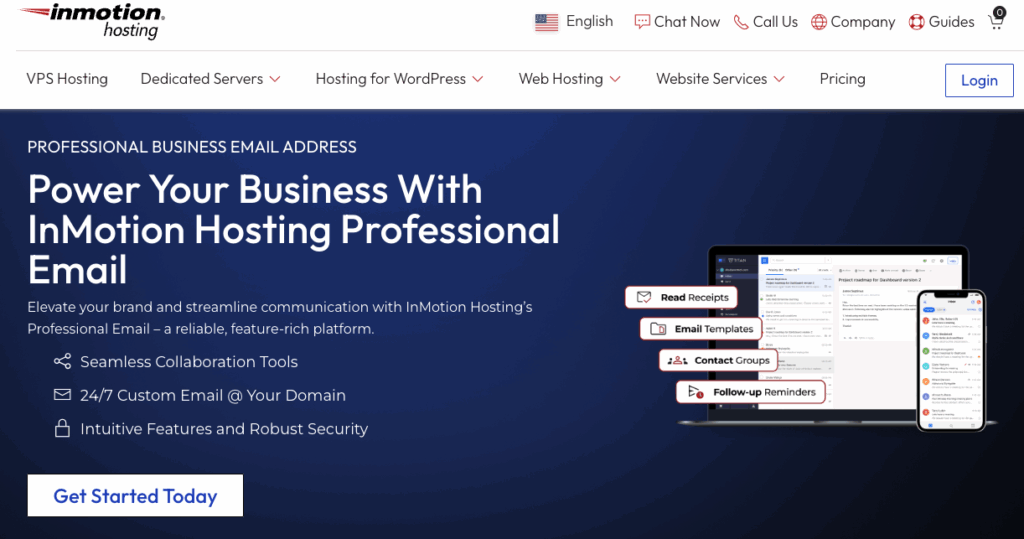
InMotion Hosting provides email options that fit different business needs. Bundled email comes standard with hosting plans, while professional email (powered by Titan) adds advanced features like mobile apps and calendar tools. For teams that prefer Google Workspace, it’s available directly through AMP, making it easy to manage hosting, domains, and email in one place.
Looking at these competitors highlights how providers prioritize different strengths. Some focus on collaboration, others on affordability, while some emphasize administrative tools. Understanding these distinctions helps small businesses choose the provider that aligns with their immediate and long-term goals.
Google Workspace (Key Features)
- Branded email with Gmail interface
- Full suite of collaboration tools (Docs, Drive, Meet)
- Strong spam and phishing protection
- Easy setup and management

A strong option for productivity-driven teams. Keep in mind, infrastructure control and hosting-level performance tuning remain outside its scope.
Microsoft 365 Business Email (Key Features)
- Outlook integration across desktop and mobile
- Productivity apps (Word, Excel, Teams)
- Enterprise-grade security and compliance
- Reliable cloud storage and syncing
Well-suited for businesses that already rely on Microsoft’s ecosystem. Licensing costs can add up as teams grow, which is worth considering when comparing providers.
Zoho Mail (Key Features)
- Affordable plans for small businesses
- Integrated office suite and collaboration apps
- Ad-free environment with good spam filtering
- Easy admin controls for managing multiple accounts
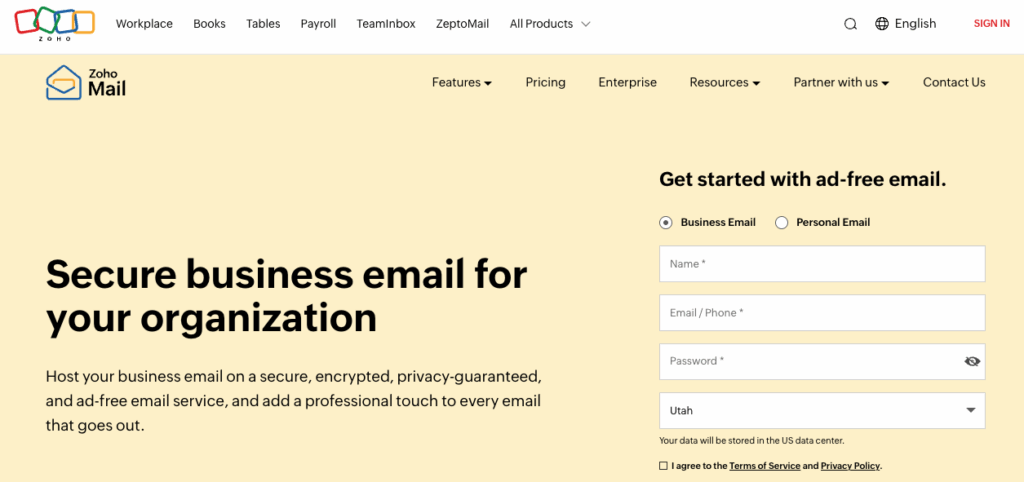
Zoho Mail offers value for budget-conscious businesses, but uptime and large-scale infrastructure commitments may differ from larger providers.
At a Glance: Email Hosting for Small Business Options
| Provider / Option | Best For | Key Strengths | Considerations |
|---|---|---|---|
| Google Workspace | Teams needing collaboration | Familiar Gmail interface, integrated apps (Docs, Meet, Drive), strong spam protection | Less control over infrastructure; higher per-user costs |
| Microsoft 365 | Businesses in the Microsoft ecosystem | Outlook + Office apps, enterprise-grade compliance, cloud storage | Licensing can get expensive as teams grow |
| Zoho Mail | Budget-conscious small teams | Affordable, ad-free, simple admin controls, integrated office tools | Smaller global infrastructure; uptime varies |
| Dedicated Email Server | Businesses needing control | Custom DNS, dedicated IP, no per-user fees, advanced security protocols | Requires technical setup and maintenance |
| InMotion Hosting | Businesses wanting growth + reliability | NVMe-powered infrastructure, SLA-backed uptime, 24/7 real human support, integrated hosting + email | Best fit for businesses ready to scale with performance and support |
How to Compare Email Hosting Providers
When comparing providers, small businesses should focus on the features that directly support growth and reliability:
Infrastructure Performance
Infrastructure performance is one of the most important factors in ensuring email reliability. Providers that use advanced storage technologies like NVMe can deliver faster processing speeds and quicker message delivery. For a small business, this means less downtime, smoother client communication, and a stronger foundation for scaling.
Cost Flexibility
How a provider structures pricing can directly impact long-term scalability. Per-user pricing can work for very small teams but may become expensive as the business grows. Flat-rate pricing allows businesses to add accounts without incurring large costs, creating a more predictable and growth-friendly investment.
Uptime Commitments
Enterprise-grade SLAs (Service Level Agreements) guarantee consistent communication. An uptime commitment of 99.9% or higher helps ensure that customer inquiries, orders, and internal communication are not disrupted. This reliability is especially important for businesses that rely on email as their main customer service channel.
Support Availability
Real human support makes a significant difference when issues arise. While automated support can resolve simple problems, 24/7 expert assistance ensures that urgent concerns are handled quickly and effectively. For small businesses without dedicated IT staff, this type of support is essential.
These differentiators help highlight the balance between affordability, performance, and long-term business needs. Key differentiators are the details that determine whether your email hosting can scale seamlessly or create bottlenecks. By focusing on performance, cost structure, uptime, and support, businesses can avoid common roadblocks. The right mix ensures that your email hosting continues to serve your needs as your business evolves.
Best Practices for Managing Business Email
Backups and Archiving
Regular backups are essential for protecting business continuity. If emails are accidentally deleted or systems experience downtime, backups ensure messages and attachments can be restored. Archiving also helps maintain compliance by preserving communication records for audits and legal requirements.
Phishing Awareness
Training staff to recognize phishing emails is one of the most effective defenses against cyberattacks. Malicious emails can trick employees into sharing credentials or clicking harmful links. Awareness programs give staff the confidence to identify suspicious activity and avoid costly mistakes.
Authentication Protocols
Protocols like SPF, DKIM, and DMARC add layers of protection to your business email. They verify that messages are genuine and prevent spoofing attacks. Implementing these standards helps keep your business domain secure and maintains trust with clients who receive your emails.
Two-Factor Authentication
Adding two-factor authentication (2FA) strengthens account security by requiring a second step, such as a mobile code, in addition to a password. This makes it much harder for attackers to compromise accounts, even if credentials are stolen. For small businesses, it’s a straightforward way to improve security.
Usage Monitoring
Monitoring email usage helps businesses track storage limits, identify unusual activity, and plan for growth. Keeping an eye on resource consumption ensures smooth performance and helps you anticipate when it’s time to scale your hosting plan.
Managing email hosting effectively means blending technology with training. Backups and authentication protect your infrastructure, while staff awareness reduces human error. By investing in both, small businesses maintain communication resilience and reduce risks that could disrupt operations.
How the Right Email Hosting Supports Business Growth
Choosing the right email hosting provider goes far beyond sending and receiving messages. It builds trust with your customers, keeps your business compliant, and creates room for growth. A dependable system keeps your inbox online when it matters most. Flexible options let you add new team members without slowing things down. And when challenges come up, real support gives you answers right away. When these pieces work together, email becomes more than a tool; it becomes a driver of your business success.
Email hosting is not just about sending and receiving messages; it’s about creating an operational backbone that supports growth. With trusted hosting, every new client interaction, employee hire, or project collaboration becomes smoother. In this way, email hosting is directly tied to how your business builds credibility and momentum over time.
Wrapping It Up
Email hosting is a critical investment for small businesses. Whether you choose bundled email with hosting, a standalone provider, or a dedicated server solution, the goal is the same: secure, reliable, and professional communication.
Where the real difference comes into play is infrastructure, uptime, and support. InMotion Hosting’s platform is engineered for speed with NVMe-powered servers, backed by a 99.9% uptime guarantee and 24/7 access to real human experts. That means you’re not only getting reliable email performance today, but also the confidence that your communications can grow alongside your business without sacrificing speed or stability.
In the end, email hosting should feel like an investment in trust and efficiency rather than just a technical tool. By choosing a provider that balances performance with personalized support, you ensure professional communication today and create the foundation for long-term growth.