
Agentic commerce is the practice of preparing your storefront so AI agents inside ChatGPT, Perplexity, and Claude can find your products, confirm pricing, and complete purchases on a shopper’s behalf. This guide walks through the technical and structural changes that decide whether your products get cited, recommended, and bought through an AI assistant, or quietly skipped in favor of a competitor who did the work.
The New Layer Between You and the Buyer
A shopper who used to type a query into Google may now ask an assistant to recommend and purchase a product in a single turn. The agent might surface a product inside a chat response, fetch live pricing through a feed, or complete the checkout itself by calling a merchant’s API. OpenAI now publishes a public Agentic Commerce Protocol that defines how merchants connect to ChatGPT’s Instant Checkout, and Anthropic and Google are signaling that their own commerce surfaces are not far behind.
This is a different problem than traditional SEO. Search engines reward pages that rank for keywords. Agents reward merchants who expose structured, machine-readable data that confirms what a product costs right now, what it includes, and how to buy it without human navigation. A page that ranks in the top three for “best VPS hosting” can still be invisible to an agent if its pricing lives behind a JavaScript-loaded toggle that a crawler cannot resolve.
The shift is more architectural than tactical. Where SEO rewarded marketing teams, agentic commerce rewards engineering teams who treat catalog hygiene as production infrastructure. If your product data is not legible at machine speed, the agent picks someone else’s.
The Three Channels Where Agents Discover Products
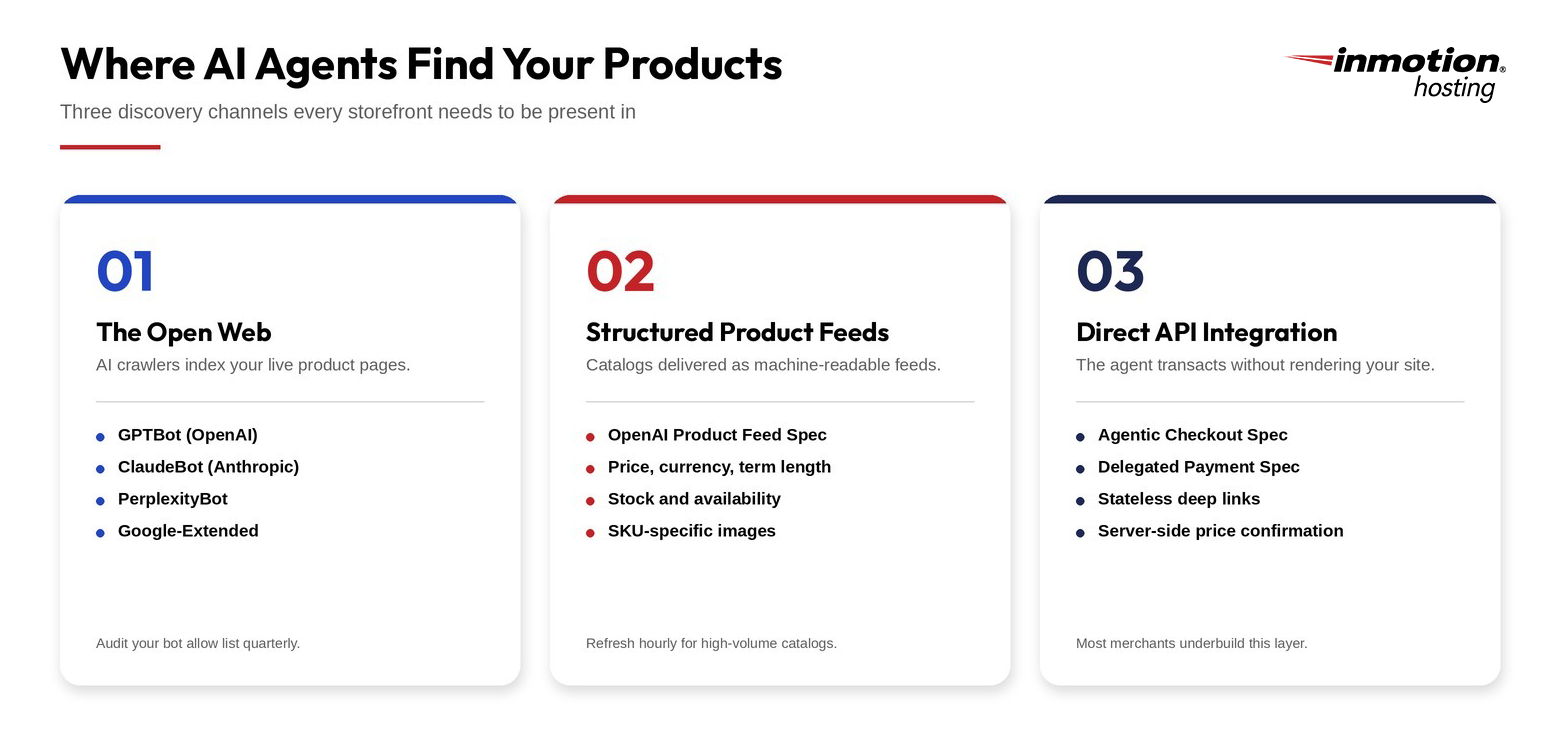
Agents pull product data from three sources, and a serious storefront needs to be present in all of them.
The first source is the open web. Crawlers operated by OpenAI, Anthropic, Perplexity, and Google index your product pages and feed that content into training data or real-time retrieval. Their behavior is different from Googlebot, and most legacy bot rules were written before these crawlers existed. Anyone who has not audited crawler access in the last 12 months almost certainly has a default ModSecurity rule or WAF template silently blocking one of them. We covered this in detail in our guide to how AI crawlers work, which is worth reading alongside this piece if you have not already audited your crawler access.
The second source is structured product feeds. OpenAI’s Product Feed Specification defines exactly how merchants share catalog data, including price, availability, descriptions, and images. The agent reads this feed instead of scraping your site, so the data is more reliable and updates faster. This is the lever most merchants underuse, because it does not require touching the storefront codebase.
The third source is direct API integration through checkout and payment specs. Once an agent decides which product to recommend, it can call your endpoint to confirm price, reserve inventory, and process a transaction without ever rendering your storefront in a browser. This is the layer that turns a recommendation into a sale.
A store that wins shows up in all three. A store that only optimizes for one is leaving room for a competitor.
Inside OpenAI’s Agentic Commerce Protocol
The protocol has three specifications, and each one solves a different problem.
The Agentic Checkout Spec covers how ChatGPT communicates order details, addresses, and confirmations to your commerce stack. Merchants implement this to run the actual purchase inside ChatGPT while orders, inventory, and compliance stay on their own systems.
The Delegated Payment Spec defines how payment service providers receive and tokenize card data from OpenAI. Stripe, Adyen, and similar PSPs have either shipped or are shipping support. If your payment processor does not support delegated payment yet, that conversation belongs on your roadmap.
The Product Feed Spec controls what shows up in ChatGPT’s product search and shopping cards. This is the most accessible starting point because it does not require backend integration work, only a clean catalog feed delivered over HTTPS.
Merchants who want to participate in Instant Checkout must apply through chatgpt.com/merchants. Approval is selective right now, but the underlying protocol is open. Build against it before approval lands and you compress your time to revenue when the door opens.
The Catalog Is the Foundation, Not the Product Page
Every other agentic commerce capability depends on whether your catalog is clean. Specifically:
- Each product needs a unique, persistent ID
- Every product needs a custom image, not a stock template
- All products need a description written for that specific SKU, not boilerplate shared across plans
- Pricing must include the actual transactable price, the term length, and currency
- Availability must reflect real-time inventory, not cached values from yesterday
If you cannot answer the question “what does this product cost right now in USD on a 12-month term?” from a single feed row, your catalog is not ready. The same gaps that block Google Merchant approval, missing images, vague descriptions, ambiguous pricing, will block agentic commerce inclusion.
Most ecommerce stores discover this the hard way. They assume the product page is the source of truth, then realize the product page is a marketing template that pulls partial data from three different systems. The fix is to consolidate the catalog into a single source that both your marketing site and your feed pull from. That work is rarely glamorous and almost always pays for itself within a quarter.
Product and Offer Schema, Done Right
Product and Offer schema is how non-feed crawlers, including search-mode LLMs like Perplexity, understand your pricing. Use Product schema on every individual plan or SKU page. Include name, description, image, sku, and at least one Offer with price, priceCurrency, priceValidUntil, and availability.
Two specifics matter here. The price in your schema should reflect what the customer will actually be charged at the term length you show on the page. A monthly equivalent price built from a 12-month commitment is fine, but make that explicit in the schema with priceSpecification. Term length belongs as machine-readable metadata, either through unitText on the offer or a hidden span with a clear class name that crawlers can parse.
A common mistake is to display a promotional price on the page while the schema still lists the renewal price, or vice versa. Agents trained on this conflict will surface whichever number they reach first, and you lose control of the conversation. Audit your schema against your live page price at least monthly. That cadence sounds aggressive until you see how often a promotional run leaves stale schema behind on three or four templates.
If you sell add-ons that combine into a bundle, like a managed service stacked on a hosting plan, those bundle prices belong in your catalog and your schema. Otherwise the agent can only quote the base product and will miss the actual offer.
The Cart Subdomain Question
The most common architectural question is whether to open the cart to AI crawlers. The answer is mostly no, with caveats.
Traditional ecommerce sites split into two funnels. A marketing domain handles discovery and education. A separate subdomain or path handles the cart and checkout, typically blocked from search engines through noindex, nofollow and robots.txt rules. The reason is simple. Cart URLs are parameter-heavy, session-dependent, and create infinite duplicate variations that destroy crawl budget.
Opening that subdomain to agentic crawlers does not solve the agentic commerce problem. Browser-based agents that execute checkouts navigate live pages as a user. They do not respect noindex the same way Googlebot does, because they are not crawling. They are acting. What matters for those agents is not whether the cart is indexed, but whether the cart URL structure is predictable and operable without JavaScript fallbacks.
A small set of changes improves machine legibility without opening the floodgates:
- Clean, parameter-free deep links to specific plans, like
/checkout/blue-kayak, that an agent can reconstruct from product data - A clear, stable “Add to Cart” link that resolves to a real URL even when JavaScript is disabled
- An llms.txt file at your root that maps the purchase journey from discovery page to checkout endpoint
- Rate limiting that distinguishes legitimate AI crawlers from scrapers and credential-stuffing bots
The temptation to flip the whole cart subdomain to index, follow is usually a mistake. The crawl budget waste outweighs the agentic upside. The opportunity is at the discovery layer, on your marketing pages, where you have content control.
URL Patterns That Survive Agent Traversal
Agents thrive on URL patterns they can construct from product knowledge alone. A pattern like /ocean-kayaks/two-person-kayak is easy to reach. A pattern like /cart?session_token=abc123&product_id=4471&promo=spring25 is unreachable for any agent that does not first navigate the human flow.
For agentic commerce, audit your URL structure against three questions:
- Can an agent reach the checkout for a specific product without first visiting your homepage?
- Does that URL survive without a session token in the query string?
- Will the price displayed at that URL match the price in your feed and schema?
If any of those answers is no, that gap will show up as missed conversions through agentic channels. Fixing the URL structure is a one-time engineering investment that pays back across every AI surface, ChatGPT, Perplexity, Claude, and whatever ships next.
This is where costs usually creep up. Teams underestimate how much technical debt lives in URL routing, and the audit surfaces issues the marketing team did not realize were there.
Feed Freshness and the Cost of Stale Data
Feed freshness is where most merchants underperform. OpenAI’s spec recommends updating the feed whenever products, pricing, or availability change. In practice that means hourly for high-volume catalogs and at least daily for everything else.
Stale data hurts in three ways. Out-of-stock items get recommended and the agent’s transaction fails. Old promotional pricing surfaces, so a customer expects a discount that is no longer live. Renewal prices appear where introductory prices should, and trust collapses on the first invoice.
Build a feed generation job that runs on schedule, validates against the spec, and pushes to your allow-listed endpoint over HTTPS. Log every push and every rejected record. Monitor for drift between your feed price and your live page price. When the two disagree, the feed is usually right, but only if your catalog is the actual source of truth.
A managed hosting environment with reliable cron access and predictable performance, like a Managed VPS, removes a class of feed-failure problems that shared environments introduce. Cron jobs that get killed mid-run for resource use, IP addresses that get rate-limited by OpenAI for inconsistent response, and TLS handshakes that time out during peak windows all live in the same operational category. Predictable infrastructure makes the problem go away.
Five Patterns That Quietly Block Agentic Commerce
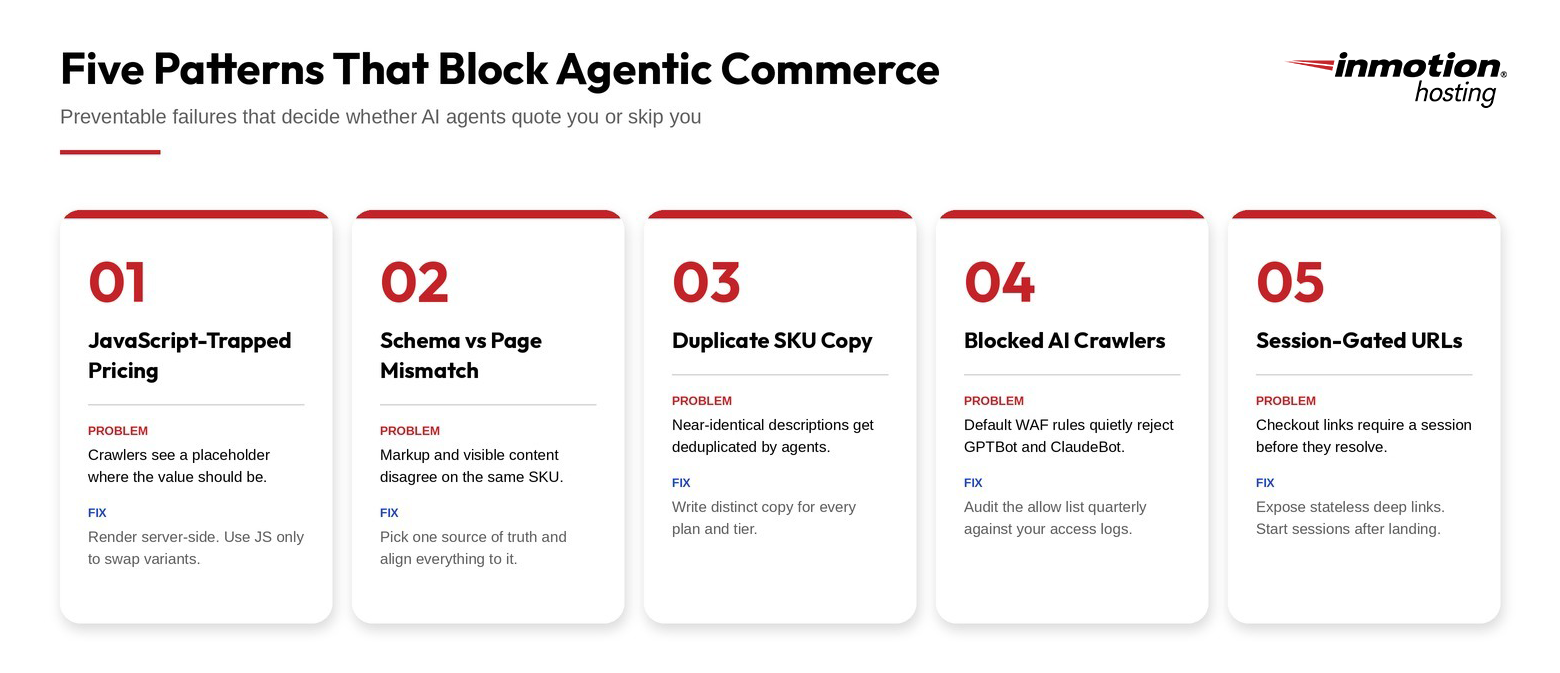
Five patterns come up repeatedly when auditing ecommerce sites for agent readiness.
Pricing trapped behind JavaScript toggles. If a crawler renders the page and sees a placeholder where the price should be, the agent cannot quote you accurately. Render the default price server-side and use JavaScript only to swap variants.
Product schema that contradicts the page. A Service schema with one price, a Product schema with another, and a visible price that matches neither. Pick one source of truth and align everything to it.
Identical descriptions across multiple SKUs. Agents deduplicate near-identical entries, so if your Power and Pro plans share 90 percent of their description text, only one will be cited.
Aggressive bot blocking that catches legitimate AI crawlers. Default ModSecurity rules and WAF templates still block GPTBot, ClaudeBot, and PerplexityBot by mistake. Review your access logs and your allow list quarterly. That surprises a lot of store owners.
Checkout URLs that require a session before they resolve. If your “buy now” link 302-redirects through a session creation page, half the agents trying to reach it will bounce. Provide a direct, stateless URL for the agent to land on, then start the session at that step.
These five represent the bulk of preventable failures. A team that fixes only these moves further ahead than 80% of competitors who have not started.
A Self-Audit for Agent Readiness
Three checks give you a clear read on where you stand today.
Run your top product pages through a structured data testing tool and confirm Product, Offer, and price data parse cleanly. Compare the schema price to the on-page price and the feed price. All three should match for any term length you advertise.
Ask ChatGPT, Perplexity, and Claude directly. Type “what is the cost of [your product] on a 1-year term” and check the answer. If the agent quotes a wrong number, an outdated promo, or refuses because it cannot confirm, you have a data gap. The merchants who win at agentic commerce treat this kind of test as routine monthly QA, the way SEO teams once treated SERP tracking.
Check your server logs for AI crawler activity. GPTBot, ClaudeBot, PerplexityBot, and similar user agents should appear regularly. If they do not, you are either being blocked or you are not surfacing in the queries that drive their crawls. Both are fixable.
A passing audit looks like a flat triangle. Schema, feed, and live page all agree. Crawlers reach your URLs without challenge. The agent answers correctly when asked.
The Infrastructure Layer Underneath All of This
Agentic commerce assumes your infrastructure can serve clean data quickly and consistently. That includes server-side rendering for product pages, reliable feed delivery over HTTPS, and the performance headroom to handle AI crawler traffic alongside human shoppers. Shared environments without resource guarantees often fall short on the third point, throttling crawlers during peak hours and creating gaps in your indexed coverage.
For stores building toward agentic commerce, the infrastructure conversation usually points to Managed VPS Hosting or Dedicated Servers, depending on traffic and catalog size. Our team helps merchants audit crawler access, validate feed delivery, and tune server response time for both human and machine traffic. If you want a second set of eyes on your setup before applying for Instant Checkout or expanding into Perplexity Shopping, talk to our sales team.
The merchants who move first are buying themselves a structural lead. Catalog cleanup, schema alignment, and URL hygiene make your site legible to agents today and will keep paying off as Anthropic, Google, and others ship their own commerce protocols over the next 12 months. Treat agentic commerce as infrastructure, not marketing, and the AI assistants will keep recommending you.
Additional Guides & Tools
Blog
Stay updated with the latest web hosting news, tips, and trends. Explore our expert articles to enhance your online presence and keep your website performing at its best.
Support Center
Get 24/7 assistance from our dedicated support team. Access a wealth of resources, tutorials, and guides to solve any hosting issues quickly and efficiently.
Managed Hosting
Experience high-performance, secure, and reliable managed hosting solutions. Let our experts handle the technical details while you focus on growing your business.